



The Low-Tox Home Guide: 5 Evidence-Based Ways to Reduce Exposure and Waste
Five practical, evidence-based ways to create a healthier, lower-tox home – without throwing everything out, becoming afraid of chemicals or trying to be perfect.
Written by Christina Hawkes, Co-founder, Greenscents · Updated September 2026
Creating a healthier home can feel surprisingly complicated.
We are told to avoid plastic, choose natural ingredients, buy fragrance-free products, improve indoor air, reduce waste, recycle more, read labels and look for sustainable brands. Before long, creating a “low-tox home” can begin to sound like an expensive project in which everything already owned needs to be replaced.
We think there is a better approach.
A lower-tox home is about understanding where unnecessary exposures and waste occur in everyday life and making thoughtful changes where they can have the greatest effect. Sometimes that means choosing a different product. Sometimes it means using less, improving ventilation, refilling what you already have or simply asking better questions.
This guide looks at five areas that can make a practical difference: persistent fragrance, indoor air, plastic and waste, cleaning-product formulation and independent certification.
At a glance: five ways to create a lower-tox home
- Reduce unnecessary persistent fragrance, particularly in laundry and products designed to scent the air continuously.
- Improve indoor air through ventilation and by looking at all the sources that contribute to it.
- Think beyond the bottle – prevention, refill, repair and reuse can matter as much as recycling.
- Choose cleaning products by function and ingredients, rather than fragrance, colour, thickness or foam.
- Look for independent evidence behind environmental and organic claims, rather than relying on green-looking packaging.
Prefer to read offline? Download the Low-Tox Home Guide (PDF) →

1. Why Can I Smell My Neighbour’s Laundry?
What persistent fragrance can tell us about the products we use
A clean home doesn’t have to smell artificial.
You step outside on a sunny morning. Someone nearby has hung out their washing. Before you can see it, you can smell it. The fragrance drifts across the garden, along the pavement or through an open window.
We have become so accustomed to strongly fragranced laundry that we rarely stop to question it. But perhaps we should.
How can we still smell clothes hours – or even days – after they have been washed? What makes fragrance remain attached to fabric? And is it reasonable for one person’s choice of laundry fragrance to become part of the air that everyone around them breathes?
Modern laundry fragrance is sophisticated chemistry. Many conventional laundry products use complex fragrance mixtures, which may contain numerous individual substances. Many of these fragrance materials are produced by chemical synthesis, and a significant proportion of synthetic aroma chemicals are derived wholly or partly from petrochemical feedstocks, although some fragrance molecules can also be produced from renewable raw materials or biotechnology.
Some products also use technologies designed specifically to make fragrance persist on fabric and release gradually during wear, movement or friction. Microencapsulation is one example: tiny polymer capsules containing fragrance can be deposited on textiles during washing and release scent later when clothes are rubbed, folded or worn.
These technologies can make clothes smell “fresh” for days or even weeks. But this raises an important question: is fragrance there to improve cleaning – or to create the perception of cleanliness long after the washing has finished?
What the evidence says
Fragrance is one of the most powerful sensory signals we use to judge cleanliness. Our perception of whether something is clean can be strongly influenced by how it smells. This helps explain why manufacturers invest heavily in developing distinctive and increasingly persistent fragrances for laundry and household products.
But fragrance and cleanliness are not the same thing. Laundry detergents clean because surfactants and other functional ingredients help remove dirt, grease and residues from fabric. Fragrance does not make clothes cleaner.
Modern fragrance technology can extend far beyond simply adding perfume to a bottle. Reviews of laundry fragrance encapsulation describe how microcapsules are used to protect volatile fragrance compounds during washing and release them gradually afterwards. Other formulation strategies use fragrance materials with different evaporation rates or materials that help scent remain associated with fabric.
This means that what we smell on freshly washed clothes may not simply be fragrance left behind accidentally. Persistence can be part of the product design. This persistence can also have an environmental downside where polymer microcapsules are used and washed into wastewater.
For people with fragrance allergies or sensitivities, exposure to fragranced products can also be an important consideration. Fragrance is a well-recognised cause of allergic contact dermatitis. Synthetic fragrance mixtures may contain many individual aroma chemicals, some of which are recognised fragrance allergens.
Natural fragrances are not automatically risk-free either: essential oils contain biologically active compounds such as limonene and linalool, and their oxidation products can also be relevant allergens for some people.
The point is not that all fragrance is harmful. The more useful question is whether we need fragrance everywhere, all of the time.
DID YOU KNOW? The word “fragrance” on a label rarely means one ingredient. It can refer to a proprietary mixture containing many individual fragrance materials, some of which may not be fully disclosed.
What you can do
Start by looking for fragrance you may barely notice any more. Laundry products are an obvious place to begin, but also think about air fresheners and plug-ins, scented candles, fabric sprays, dryer sheets, strongly fragranced cleaning products, toilet fragrances and products designed to create a permanent background scent.
You do not need to remove everything at once. Choose one source of persistent fragrance and try living without it for a few weeks.
If you enjoy fragrance, you do not necessarily have to give it up. Instead, think about where you want fragrance in your home, why you want it there and how long you want it to remain. Fragrance can be a conscious choice rather than a constant background exposure.
The Greenscents approach
We believe fragrance should be a choice, not a residue.
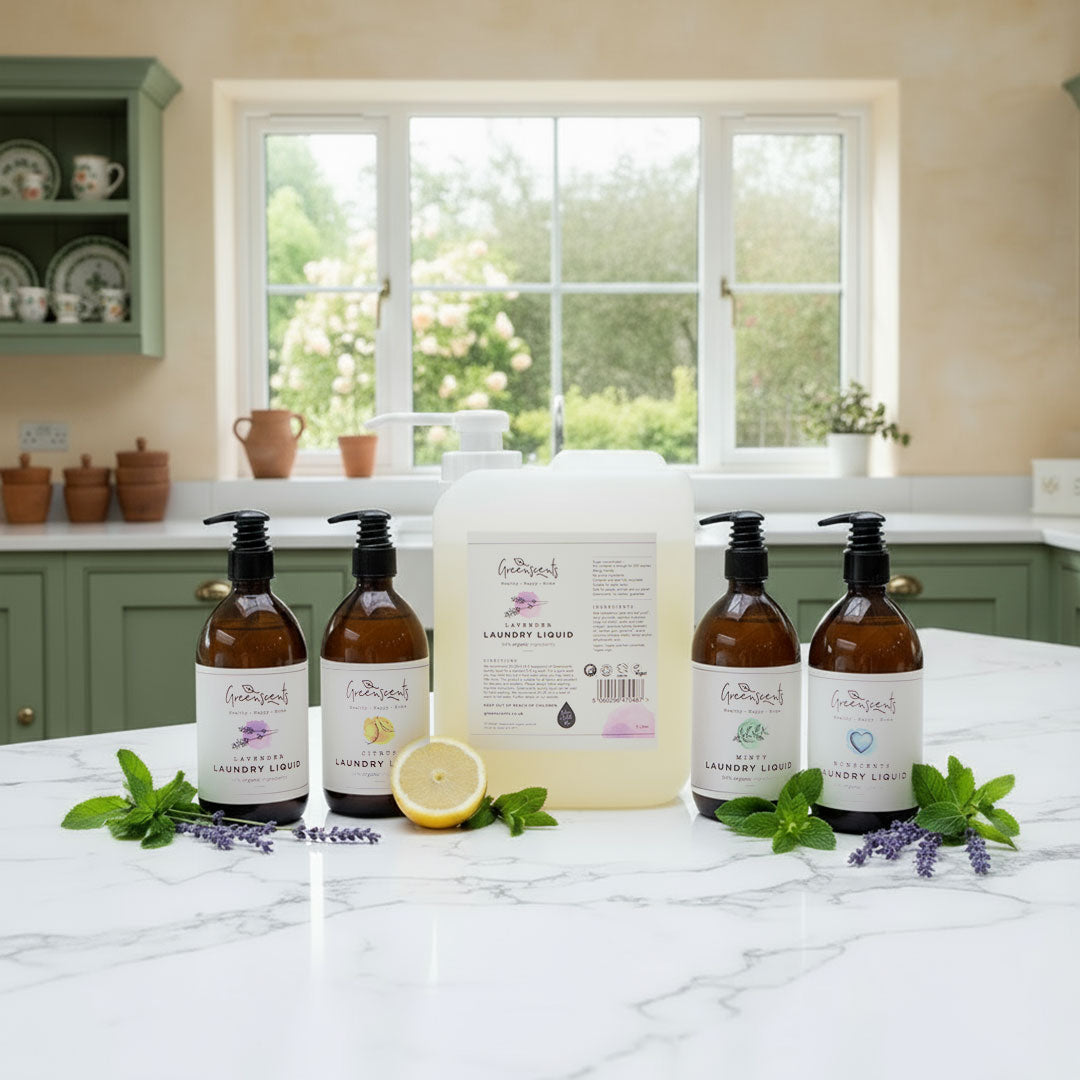
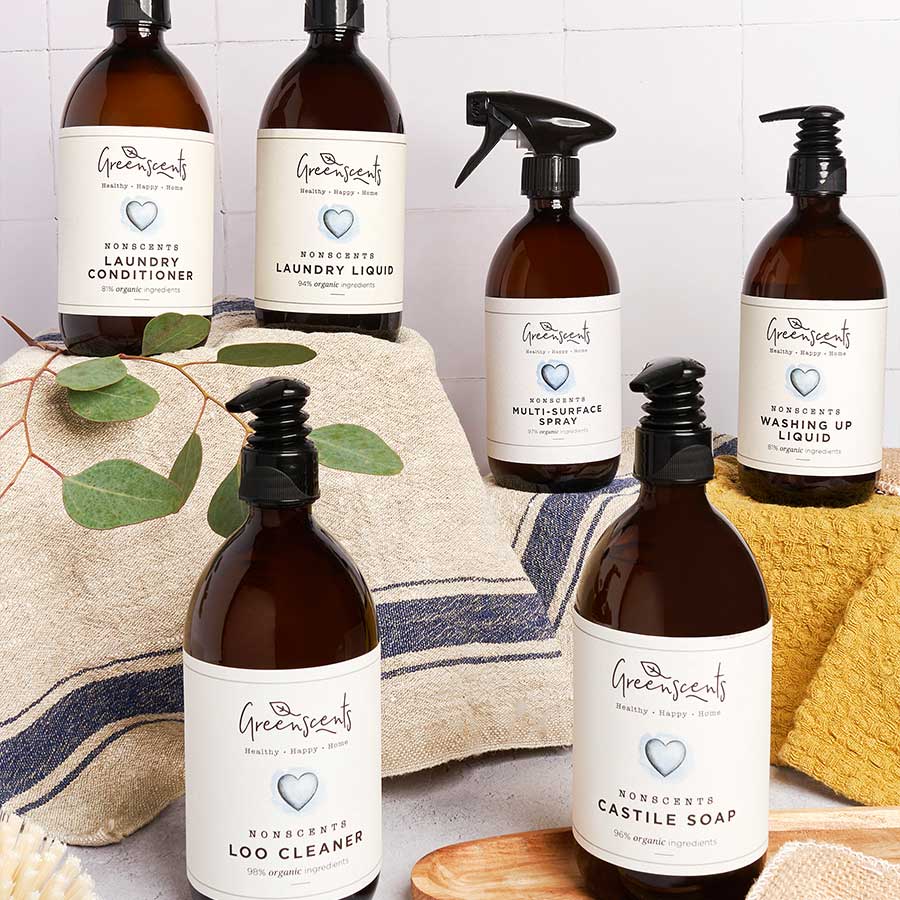
That is why we offer completely fragrance-free products alongside products fragranced with carefully selected organic essential oils.
Our aim is not to make your laundry announce itself from the other side of the garden. It is to create effective cleaning products that do their job and rinse as cleanly as possible. Because clean clothes shouldn’t need to announce themselves.

2. What’s Really Floating Around Your Home?
Why creating healthier indoor air is about much more than changing your cleaning products
Fresh air doesn’t smell of perfume. It simply smells fresh.
Most of us worry about air pollution when we leave the house: traffic, factory chimneys and busy roads. Yet we rarely stop to think about the air inside our own homes.
This is surprising because we spend the vast majority of our lives indoors. Everyday activities contribute to a constantly changing indoor environment: cooking dinner, lighting a candle, painting a room, vacuuming, cleaning the kitchen, running the dishwasher, drying laundry indoors or bringing new furniture into the house.
None of these activities is unusual. They are part of everyday life. The important question is: how do all these everyday activities work together to influence the air we breathe?
What the evidence says
Indoor air quality has become an increasingly important area of environmental health research. Scientists now understand that indoor air is a complex and constantly changing mixture of gases, particles and biological material.
Cooking can be a significant source of indoor air pollution. Frying, grilling and roasting can release particles into the air, while gas appliances can contribute pollutants including nitrogen dioxide. Candles, incense, paints, furnishings, building materials and household products can all contribute additional substances to the indoor environment.
Cleaning products form one part of this bigger picture. Fragranced products can release volatile organic compounds, or VOCs, into indoor air. Some are synthetic fragrance ingredients; others occur naturally in essential oils. Once released, these compounds do not necessarily remain unchanged. Indoor air is chemically active, and some VOCs can react with other substances, including ozone entering buildings from outdoors, to create secondary pollutants.
Dishwasher products raise a different set of questions involving ingredients, residues and what enters wastewater. We cover these separately in our dedicated dishwasher guides.
Perhaps the most useful message from the research is that there is rarely one single cause of poor indoor air quality. Our indoor environment reflects hundreds of everyday activities and decisions.
DID YOU KNOW? In developed countries, people are often estimated to spend around 90% of their time indoors, making indoor air an important part of everyday environmental exposure.
What you can do
Improving indoor air does not require you to become anxious about everything in your home. Quite the opposite. Because indoor air is influenced by many different sources, there are also many opportunities to improve it.
Use extractor fans while cooking, particularly when frying or grilling. Ventilate after cooking and cleaning whenever practical. Avoid using air fresheners simply to mask unpleasant odours: try to identify and remove the source instead.
Think about candles, incense, wood burners, damp, new furniture, decorating products and household products – not just surface cleaners. If you dry laundry indoors, ventilate the room to help reduce moisture. And consider whether every fragranced product in your home really needs to be fragranced.
No single action creates perfect indoor air. Together, however, small changes can reduce unnecessary exposures and create a healthier indoor environment.
The Greenscents approach
One of the most important lessons we have learned over the last fourteen years is that healthier homes are rarely created by one “perfect” product. They are created by hundreds of thoughtful decisions.
Good ventilation. Thoughtful product formulation. Reducing unnecessary persistent fragrance. Using concentrated products. Reading ingredient information. Looking for evidence behind environmental claims.
We do not believe cleaning products are the whole answer. But we do believe they should quietly do their job, rinse as cleanly as possible and allow fresh air – not artificial fragrance – to become the defining smell of a healthy home.

3. Is Plastic Really the Biggest Problem?
Why sustainable cleaning is about much more than choosing a different bottle
The environmental impact of a cleaning product depends on far more than the bottle it comes in.
Plastic has become one of the defining environmental issues of our time. Understandably, many of us now look for cleaning products described as “plastic free”, “recyclable” or “made from recycled plastic”.
Reducing unnecessary plastic is an important environmental goal. But when it comes to household cleaning products, focusing only on the bottle risks missing a much bigger opportunity.
Cleaning and laundry products are purchased repeatedly throughout the year. Small improvements in the way they are formulated, packaged, transported and reused can therefore have a significant cumulative impact.
Perhaps the better question is not simply: what is this bottle made from? Perhaps it is: how has this entire product been designed?
What the evidence says
Environmental scientists increasingly encourage us to consider products across their whole life cycle: from raw materials and manufacture through transport and use to eventual reuse, recycling or disposal.
For cleaning products, this produces some interesting conclusions. The first is that the greatest environmental benefits can occur before recycling even begins. The UK waste hierarchy places waste prevention first, followed by preparing for reuse and then recycling. Recycling is important, but it still requires collection, transport, sorting and industrial processing.
Keeping products and materials in use for longer can preserve more of the resources already invested in making them. This thinking sits at the heart of the circular economy, which asks how products and materials can remain in use for as long as possible rather than following a traditional “take, make and dispose” model.
Cleaning products are particularly well suited to this approach because they are purchased so frequently. Instead of manufacturing and disposing of another bottle every time a product runs out, refill systems allow containers to be used repeatedly.
But packaging is only part of the story. Concentration matters too. Many liquid cleaning products contain large quantities of water. Water may be essential to the formulation, but transporting more water also means transporting more weight, using larger containers, requiring more storage and potentially increasing transport impacts.
Life-cycle studies of detergent products and packaging repeatedly show that the environmental profile of a product depends on much more than one material choice. Packaging format, product concentration, transport, consumer use and end-of-life treatment all matter. Concentrated products can reduce the amount of packaging and material required to deliver the same number of cleaning applications.
The environmental savings do not necessarily come from one dramatic innovation. They come from removing unnecessary resource use throughout the product’s life cycle: less packaging, less material, less transport and less waste.
DID YOU KNOW? The waste hierarchy puts prevention and reuse above recycling. Recycling matters, but preventing waste in the first place is usually better.
What you can do
First, use what you already own. Creating a more sustainable home does not mean throwing away perfectly serviceable plastic products and replacing them with attractive new “eco” alternatives.
Keep using bottles and containers for as long as they remain safe and functional. Choose refills where practical. Look for concentrated products and compare how many washes or cleaning applications you receive rather than simply comparing bottle size.
Replace worn pumps and sprays rather than replacing an entire bottle. And before recycling something, ask whether it could be reused instead.
A healthier, more sustainable home is not created by buying more things. Often, it begins by making better use of what we already have.
Multi-purpose products can also reduce the number of separate products a household needs. Our guide to Castile Soap looks at how one concentrated product can cover a number of everyday cleaning and laundry jobs.
The Greenscents approach
When we developed our refill system, our aim was not simply to reduce plastic. We wanted to rethink the whole life cycle of a cleaning product.
Could we create highly concentrated products? Could customers refill their glass bottles at home rather than replacing them every few weeks? Could our larger refill containers be returned, professionally cleaned, inspected and reused many times before eventually reaching the end of their working lives?
Then we looked beyond the bottles themselves. If customers are going to keep bottles for many years, they need to be able to replace the parts that naturally wear out. That is why we offer replacement pumps, trigger sprays and bottle labels. A worn label or broken spray should not mean replacing an entire bottle.
Our 5-litre and 20-litre containers can also be returned to us free of charge for inspection, cleaning and reuse.
For us, sustainable cleaning is not defined by one environmentally friendly feature. It comes from looking at the whole product: formulation, concentration, packaging, transport, refill, repair, reuse and, finally, recycling. Because the best environmental solutions begin long before something reaches the recycling bin.

4. How Should You Choose a Cleaning Product?
Why the things we notice first are not always the things that matter most
Good cleaning is measured by what a product removes – not by what it adds.
What makes you choose one cleaning product rather than another? The fragrance? The colour? The thickness of the liquid? The amount of foam? The promise of “long-lasting freshness”?
Most of us do not consciously think about these questions. Yet they influence the way we judge products every day.
The thicker the liquid, the better it must clean. The more foam it produces, the more powerful it must be. The stronger the fragrance, the fresher our home must be.
These assumptions feel natural because our brains constantly use sight, smell and touch to judge the world around us. But do these sensory signals help us choose products that reduce unnecessary exposures and clean effectively – or do they simply influence how we perceive a product?
What the evidence says
Research into consumer behaviour and sensory perception shows that people use visual, tactile and olfactory cues when judging products. These cues can influence our expectations before we have any objective evidence of performance.
Foam is perhaps the most familiar example. Many people associate abundant foam with powerful cleaning. Yet cleaning performance comes from the chemical interactions that allow surfactants and other functional ingredients to remove grease and dirt – not simply from the bubbles we can see. In some applications, including automatic dishwashing, excessive foam can actually interfere with effective operation.
Viscosity tells a similar story. A thick liquid can feel richer, stronger or more concentrated, but thickness alone is not a reliable measure of cleaning performance. Colour also shapes expectations, creating associations with freshness, hygiene or strength despite contributing nothing directly to cleaning.
Fragrance can be especially powerful. Classic psychology research shows that exposure to a cleaning-related scent can make cleaning concepts more mentally accessible, while wider research on fragranced products shows that scent affects emotional response, memory and product experience. This helps explain why a strongly fragranced product can feel more effective even when fragrance does not contribute to cleaning itself.
This creates an interesting challenge for formulators. Should products be designed to satisfy consumer expectations, or should they be designed around the ingredients genuinely needed to deliver effective cleaning?
Green chemistry provides a useful perspective. Chemical products should be designed to achieve their intended function while reducing unnecessary hazards and resource use wherever possible. For a formulator, that leads to a remarkably simple question: why is this ingredient here?
What you can do
If you want to reduce unnecessary exposures in your home, begin by looking beyond the sensory signals used to sell cleaning products.
Do you need five highly fragranced specialist cleaners when one or two effective products could do the same jobs? Does extra foam make the product work better, or simply feel more powerful? Does a bright colour improve performance, or only appearance? Does persistent fragrance make your home cleaner, or simply more perfumed?
That does not mean every additional ingredient is harmful or unnecessary. Cleaning formulations are complex. Some ingredients remove dirt and grease. Some improve performance in hard water. Some control pH. Some protect the formulation from microbial contamination. Some improve stability and ensure the product works consistently throughout its shelf life.
Creating a healthier home is not about trying to eliminate chemistry. It is about reducing unnecessary exposures wherever practical while maintaining excellent cleaning performance.
The more useful question is not: how few ingredients does this product contain? It is: does every ingredient have a clear purpose?
The Greenscents approach
Every Greenscents formulation begins with one question: why is this ingredient here?
If it improves cleaning performance, it earns its place. If it helps a product work effectively in hard water, it earns its place. If it protects the formulation, improves stability or ensures product quality throughout its shelf life, it earns its place.
But if an ingredient exists primarily to create more foam, produce a brighter colour, make a liquid appear thicker or leave a fragrance lingering long after cleaning has finished, we ask whether it is really necessary.
Sometimes the answer is yes. Often, it is not.
Our aim has never been to create products with the fewest ingredients. Our aim is to create products in which every ingredient has a purpose.
We believe cleaning products should be judged by what they remove from your home – not by what they add to it. Every ingredient should earn its place in the bottle.

5. Who Should You Trust?
Why independent evidence matters more than marketing claims
Anyone can make a claim. The important question is: who has checked it?
Choosing cleaning and laundry products has never been more confusing. Natural. Eco. Green. Plant-based. Non-toxic. Kind. Sustainable. Planet friendly.
Some claims are supported by robust evidence and independent assessment. Others are simply marketing language.
The same problem applies to the growing number of symbols and logos displayed on product packaging and websites: leaves, trees, globes, hearts and green circles.
Some represent recognised independent certification schemes with published standards and ongoing scrutiny. Others are simply attractive graphics designed by the brand itself. They may look reassuring, but they do not necessarily have any independent status at all.
So how can you tell the difference?
What the evidence says
Concern about misleading environmental claims – often described as greenwashing – has grown rapidly. Environmental claims can influence purchasing decisions, while consumers may find it difficult to determine which claims are meaningful, which are independently verified and which are simply marketing.
Regulators have recognised this problem. The UK Competition and Markets Authority’s Green Claims Code requires environmental claims to be truthful and accurate, clear and unambiguous, and supported by credible evidence. The CMA also makes clear that environmental claims include not only what a business says, but how it presents information, including the use of green logos or imagery.
The European Commission has reported that a large proportion of environmental claims are vague, misleading or unsupported, and that many environmental labels provide weak or non-existent verification.
Appearance is not evidence. A green leaf created by a company’s graphic designer may be perfectly legitimate as part of its branding, but it is not the same as independent verification.
Recognised independent certification works differently. A meaningful certification scheme is based on defined standards. The company must demonstrate that it meets those standards, and compliance is assessed by someone other than the company making the claim. Depending on the scheme, this may involve examining ingredients, formulations, manufacturing processes, environmental management or ethical standards, together with regular assessment and ongoing scrutiny.
Certification is not a guarantee that a product is perfect. Different schemes assess different things. That is why it is worth becoming familiar with the independent certifications that matter to you. The important thing is not to count logos. It is to understand what each certification means, who awards it and what standards lie behind it.
DID YOU KNOW? Not every green logo is a certification. Some symbols are simply brand artwork; others are backed by published standards, independent assessment and ongoing verification.
What you can do
Most of us are not formulation chemists. We cannot independently assess every ingredient, visit factories or investigate every supply chain. Independent certification can help bridge that gap.
Start by becoming familiar with the certifications that matter most to you. If organic ingredients are important, learn about recognised organic standards. If animal welfare matters, investigate which organisations independently assess cruelty-free claims. If you want vegan products, learn to recognise established vegan certification.
And the next time you see an unfamiliar green logo on a product or website, look it up. Who created it? What does it mean? Are there published standards? Has the company been independently assessed?
Not every logo is a certification. Learning to recognise the difference is one of the simplest ways to become a more informed consumer.
The Greenscents approach
When we founded Greenscents, we made a decision that has shaped the business ever since. We did not want customers simply to take our word for it.
If we said our products were organic, we wanted independent experts to assess them against recognised organic standards. If we said our products were vegan or cruelty free, we wanted those claims independently scrutinised. If we made commitments about palm oil, animal welfare or environmental management, we wanted evidence and external accountability behind them.
That approach is not always easy. Independent certification requires time, work, transparency, regular assessment and considerable financial investment. For a small business, maintaining multiple independent certifications is a significant commitment. We believe it is worth it.
Greenscents products are independently certified by the Soil Association, The Vegan Society, Cruelty Free International’s Leaping Bunny programme and Palm Oil Free Certification. Greenscents is also approved by Naturewatch Foundation for animal welfare. Our environmental management system is certified to ISO 14001, and Greenscents has achieved an ethical rating of 100/100 from The Good Shopping Guide.
These organisations do not all assess the same things. That is precisely the point. They provide independent scrutiny of different aspects of our products, ingredients, environmental management and ethical commitments.
But certification is only part of our approach. We also believe in complete ingredient transparency. We explain how and why we formulate our products. We continue to examine new research. And when the evidence changes, we are prepared to ask whether our products and practices should change too.
For us, trust begins with transparency, evidence and a willingness to be independently assessed. Anyone can make a claim. The important question is: who has checked it?
Putting it all together: start with better questions
Creating a healthier, lower-tox home does not require perfection. It does not mean throwing away everything you already own. And it certainly does not mean becoming frightened of every chemical, product or environmental exposure.
It means becoming curious.
Why does my laundry still smell days after it has been washed? What affects the air inside my home? Could I refill or reuse something instead of replacing it? Am I judging a cleaning product by how well it cleans – or by how much it foams, smells and sparkles? Who has checked the claims I am being asked to trust?
These are simple questions. But they can lead to meaningful changes.
Reduce persistent fragrance where you do not need it. Improve ventilation. Use what you already own. Refill, repair and reuse before replacing. Choose effective products with purposeful ingredients. Look beyond marketing and learn to recognise meaningful independent certification.
A healthier, lower-tox home is created through thoughtful, informed and evidence-based choices.
Evidence behind this guide
This guide draws on peer-reviewed research and authoritative public sources. We have prioritised original studies, reviews and recognised regulatory guidance wherever possible.
Fragrance and laundry
Harding-Smith, E., Shaw, D.R., Shaw, M., Dillon, T.J. and Carslaw, N. (2024). Does green mean clean? Volatile organic emissions from regular versus green cleaning products. Environmental Science: Processes & Impacts, 26(2), 436-450. https://doi.org/10.1039/D3EM00439B
Bruyninckx, K. and Dusselier, M. (2019). Sustainable Chemistry Considerations for the Encapsulation of Volatile Compounds in Laundry-Type Applications. ACS Sustainable Chemistry & Engineering, 7(9), 8041-8054. https://doi.org/10.1021/acssuschemeng.9b00677
Manga, M.S., Adetomiwa, T., Marks, S., Gardy, J., Blackburn, R.S., Russell, S.J. and York, D.W. (2022). Deposition and retention of differently shaped microparticles on textiles during laundry processing. Powder Technology, 398, 117143. https://doi.org/10.1016/j.powtec.2022.117143
Cai, Y., Lin, J., Gimeno, S., Begnaud, F. and Nowack, B. (2022). Country-Specific Environmental Risks of Fragrance Encapsulates Used in Laundry Care Products. Environmental Toxicology and Chemistry, 41(4), 905-916. https://doi.org/10.1002/etc.5168
Sukakul, T., Bruze, M. and Svedman, C. (2024). Fragrance Contact Allergy – A Review Focusing on Patch Testing. Acta Dermato-Venereologica, 104, adv40332. https://doi.org/10.2340/actadv.v104.40332
Indoor air
Salonen, H. et al. (2024). Cleaning products: Their chemistry, effects on indoor air quality and implications for human health. International Journal of Hygiene and Environmental Health. https://pubmed.ncbi.nlm.nih.gov/38917624/
Waste, reuse and life-cycle impacts
Department for Environment, Food and Rural Affairs (2011). Guidance on applying the Waste Hierarchy. London: DEFRA.
Ellen MacArthur Foundation (2024). Circular Economy Principles. https://www.ellenmacarthurfoundation.org/circular-economy-principles
Kim, S., et al. (2020). Comparative Life Cycle Assessment of Multiple Liquid Laundry Detergent Packaging Formats. Sustainability, 12(11), 4669. https://doi.org/10.3390/su12114669
Green claims and certification
Competition and Markets Authority (2021; updated guidance 2026). Green Claims Code / Making green claims: getting it right across the supply chain. GOV.UK.
European Commission (2023-2026). Green claims: information on environmental claims and consumer protection. European Commission Environment.
Cleaning-product formulation and consumer perception
Anastas, P.T. and Warner, J.C. (1998). Green Chemistry: Theory and Practice. Oxford: Oxford University Press.
Holland, R.W., Hendriks, M. and Aarts, H. (2005). Smells like clean spirit: Nonconscious effects of scent on cognition and behaviour. Psychological Science, 16(9), 689-693. https://doi.org/10.1111/j.1467-9280.2005.01597.x
Herz, R.S. (2022). A three-factor benefits framework for understanding consumer preference for fragranced products. Cognitive Research: Principles and Implications, 7, 31. https://doi.org/10.1186/s41235-022-00378-6
Share