





How to detox your home for January
Simple swaps to reduce everyday chemical exposure
January often brings a desire to reset — not just diets or routines, but the spaces we live in every day. For many households, a home detox isn’t about extreme change. It’s about understanding why everyday chemical exposure matters, and where small, practical choices can make a meaningful difference.
Why reducing everyday chemical exposure matters
Most people are exposed to a wide range of chemicals every day through the products they use in their homes. Cleaning sprays, laundry detergents and washing up liquids are among the most frequent sources of exposure because they are used regularly, often indoors, and in close contact with skin, clothing and food surfaces.
Concern isn’t usually about a single product or ingredient — it’s about everyday, cumulative exposure over time.
Public health and environmental organisations highlight that concern is about cumulative exposure over time — sometimes described as the “chemical cocktail” effect¹. While individual exposures may be small, repeated daily contact can add up, particularly in enclosed indoor environments.
Research also shows that many household products release chemicals into indoor air during and after use, contributing to indoor air pollution². Indoor air can sometimes be more polluted than outdoor air, especially in winter when ventilation is reduced³. Fragranced household products are a well-recognised contributor to this indoor chemical load⁴⁵.
Because these exposures are routine and ongoing, precautionary organisations such as Breast Cancer UK encourage reducing avoidable exposure where practical — particularly from products used most often in the home¹.
"So many of our everyday products that we use in our homes contain Endocrine Disrupting Chemicals or EDCs. These are harmful chemicals that may interfere with the endocrine system by mimicking or blocking the action of hormones, which can lead to an increased risk of breast cancer as well as other health issues. Detoxing your home is one of the best steps you can take today to reduce your exposure to EDCs and thereby lower your risk of breast cancer." - Breast Cancer UK.
A home detox is therefore not about fear or perfection. It is about making informed, proportionate choices that help reduce unnecessary chemical exposure as part of everyday life.

Image credit: Vitaly Gariev via Unsplash
What is a home detox?
In the context of household products, a home detox does not mean eliminating everything at once or creating a sterile environment. It simply means:
- Reducing unnecessary synthetic chemicals where possible
- Choosing simpler formulations for everyday use
- Improving indoor air quality by avoiding heavily fragranced products
- Making gradual swaps rather than overwhelming changes
Focusing on high-frequency products is one of the most effective ways to reduce overall exposure over time¹².
Why January is a good time to start
January is often when routines are calmer and people are more open to small resets. It is also a time when:
- Homes are less ventilated due to cold weather
- Cleaning and laundry routines continue daily
- Indoor air quality can worsen due to regular use of fragranced products
Public health guidance highlights that reduced ventilation in winter can increase indoor concentrations of airborne chemicals³. Making a few targeted swaps at this time of year can therefore have a noticeable impact without requiring a full household overhaul.

Focus on the products you use most
A practical home detox works best when it starts with products that are used repeatedly and come into close contact with people every day.
Cleaning sprays and surfaces
Multi-surface sprays are often used daily and frequently contain fragrance formulations designed to linger. Studies show that fragranced cleaning products can emit volatile organic compounds (VOCs) during and after use, contributing to indoor air pollution⁴⁵. Choosing fragrance-free or simply formulated alternatives can help reduce inhalation exposure, particularly in kitchens and living spaces².
Laundry products
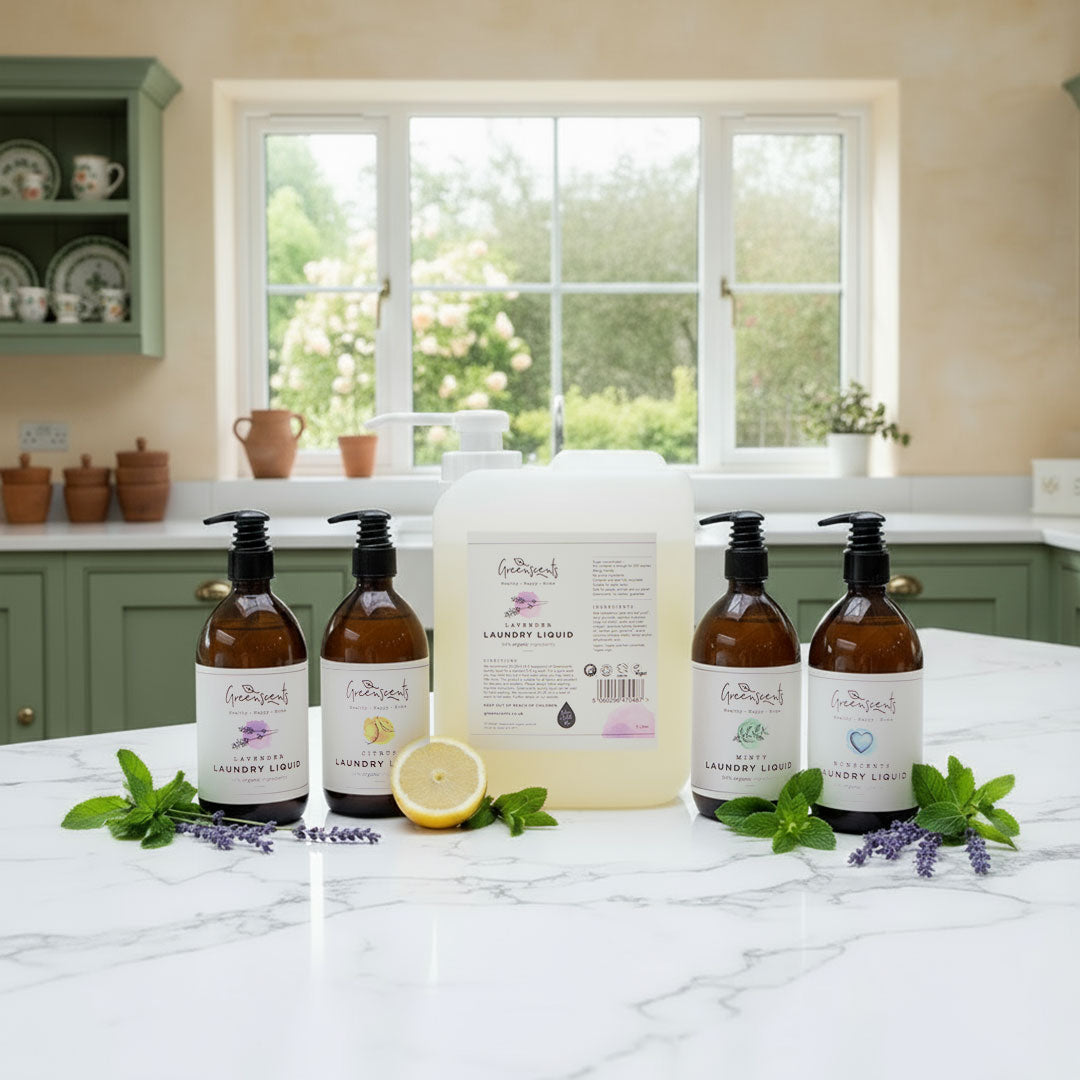
Laundry detergent residues remain in close contact with skin through clothing, towels and bedding. Research has identified laundry products as a significant source of prolonged skin and inhalation exposure to fragrance chemicals and surfactants⁶. For many households, switching to gentler, fragrance-free laundry products is one of the most effective home detox steps.
Washing up liquids
Washing up liquids are used daily on items that come into direct contact with food and hands. Simpler formulations can help reduce skin irritation and minimise chemical residues left on dishes and cookware⁷.
The role of Castile soap in a January home detox
Castile soap is often overlooked, but it can play a useful role in a home detox because of its versatility and simplicity.
Traditionally made from plant oils rather than synthetic surfactants, Castile soap can help reduce the number of different products used in the home. Reducing the total number of products can also reduce cumulative exposure to preservatives, fragrances and other additives¹².
During January, Castile soap can be used for:
- Diluted surface cleaning
- Handwashing
- Sink and tap cleaning
- Laundry pre-treatment or gentle handwashing
For households new to Castile soap, starting with a single use and expanding gradually allows routines to simplify without disruption.
Fragrance-free as a safe starting point
Fragrance is one of the most complex components of household products. A single fragrance formulation can contain dozens of individual chemicals, many of which do not need to be disclosed on product labels⁸.
Fragrance-free products provide a neutral baseline, particularly for sensitive skin, people with allergies or asthma⁹, pregnancy, and homes with babies, children or pets. Respiratory and public health organisations increasingly recognise fragrance as a contributor to indoor air pollution and irritation, particularly in enclosed spaces³⁹¹⁰.
Sensitive skin, allergies and winter flare-ups
Winter can be a particularly challenging time for people with sensitive skin, eczema, allergies or asthma. Colder weather, lower humidity and increased indoor heating can dry the skin and compromise the skin barrier, making irritation more likely. At the same time, people often rely more heavily on fragranced cleaning and laundry products while spending longer indoors, which can increase both skin contact and inhalation exposure³⁹.
Respiratory and allergy organisations note that fragranced household products can aggravate symptoms in sensitive individuals, particularly in enclosed spaces⁹¹⁰. For these households, switching to fragrance-free, simply formulated products during winter can be a practical way to reduce avoidable triggers and support skin comfort until conditions improve in spring.
A gentle, realistic approach
The most successful home detoxes are the ones that fit into real life. There is no need to replace everything at once or follow strict rules. Evidence suggests that reducing cumulative exposure through small, sustained changes is more realistic — and potentially more effective — than drastic short-term interventions¹²¹¹.
January is about setting intentions, not perfection. Reducing everyday chemical exposure through practical product choices is one small but meaningful way to support a healthier home environment over the year ahead.
References
- Breast Cancer UK. Chemicals and everyday exposures. https://chemtrust.org/wp-content/uploads/BCexposuretochemicals.pdf
- World Health Organization. WHO guidelines for indoor air quality: selected pollutants. Copenhagen; 2010. Link
- UK Health Security Agency. Indoor air quality at home. Link
- Steinemann A. Volatile emissions from common consumer products. Air Qual Atmos Health. 2015;8(3):273–281. Link
- Nazaroff WW, Weschler CJ. Cleaning products and air fresheners: exposure to primary and secondary air pollutants. Atmos Environ. 2004;38(18):2841–2865. Link
- Dodson RE, et al. Endocrine disruptors and consumer products. Environ Health Perspect. 2012;120(7):935–943.
- https://pubmed.ncbi.nlm.nih.gov/22398195/
- European Chemicals Agency. Understanding chemical exposure. Link
- Environmental Working Group. Guide to fragrance ingredients. Link
- Asthma UK. Cleaning products and asthma. Link
- British Lung Foundation. Household cleaning and lung health. Link
- European Commission. Chemicals Strategy for Sustainability. Link
- McKenzie LM, et al. Household chemical exposures and cumulative risk. Environ Res. 2014;132:373–381. Link
Further reading
Share